The GLP1Forum post "I think I butchered my tirz recon" hit 194 views and eight emergency replies within 24 hours — a distress signal from a community where reconstitution errors are the #1 source of ruined research material. The math is not hard. The consequences of getting it wrong are permanent.
The Three Classic Reconstitution Errors
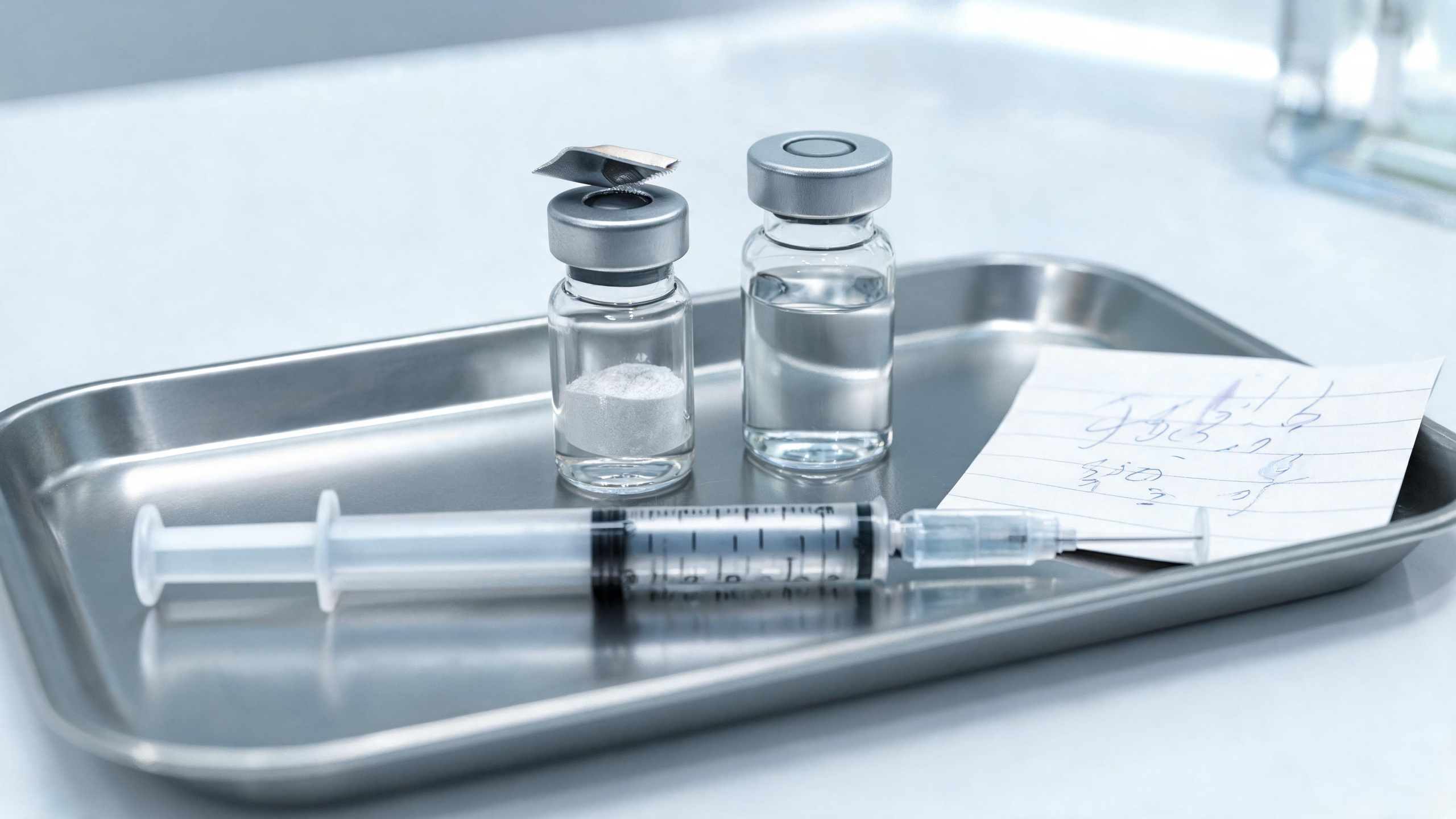
Error 1 — Wrong dilution ratio: Reconstituting 5 mg Tirzepatide with 2 mL bacteriostatic water gives you 2.5 mg/mL. A 0.2 mL research model application delivers only 0.5 mg — one-fifth of the standard 2.5 mg initial test parameter. The correct math: 5 mg ÷ 1 mL = 5 mg/mL. Your 2.5 mg test parameter = 0.5 mL transfer volume. Use a U-100 precision transfer instrument: 50 units = 0.5 mL.
Error 2 — Exceeding stability windows: Reconstituted peptides in BAC water are often handled within 14-28 days at 2–8°C, depending on sequence, concentration, and batch documentation. HGH 176-191 should be treated as a short fragment research peptide, with the working vial used conservatively and kept refrigerated after reconstitution.
Error 3 — Alcohol wipe timing: Swab the vial septum, then wait a full 30 seconds before inserting the needle. Residual isopropyl alcohol on the stopper directly denatures peptide chains on contact. This is not theoretical — peptide chemists have documented 5-10% activity loss from alcohol contamination alone.
HGH 176-191: Fragment Handling
HGH 176-191 is not full-length somatropin; it is a short synthetic fragment corresponding to residues 176-191 of human growth hormone. Handle it like a lyophilized research peptide: add diluent slowly against the vial wall, swirl gently instead of shaking, and document concentration and reconstitution date. If a solution becomes cloudy or contains visible particulates, quarantine the vial and review the batch COA before further analytical use.
Ourovia research note: Label every vial with the reconstitution date and concentration using a lab sticker. Pre-fill 0.3 mL precision transfer instruments for multi-parameter research workflows to reduce septum punctures — each puncture introduces approximately 0.1 µL of contamination risk. Store pre-filled transfer instruments at 2–8°C and use within 48 hours.