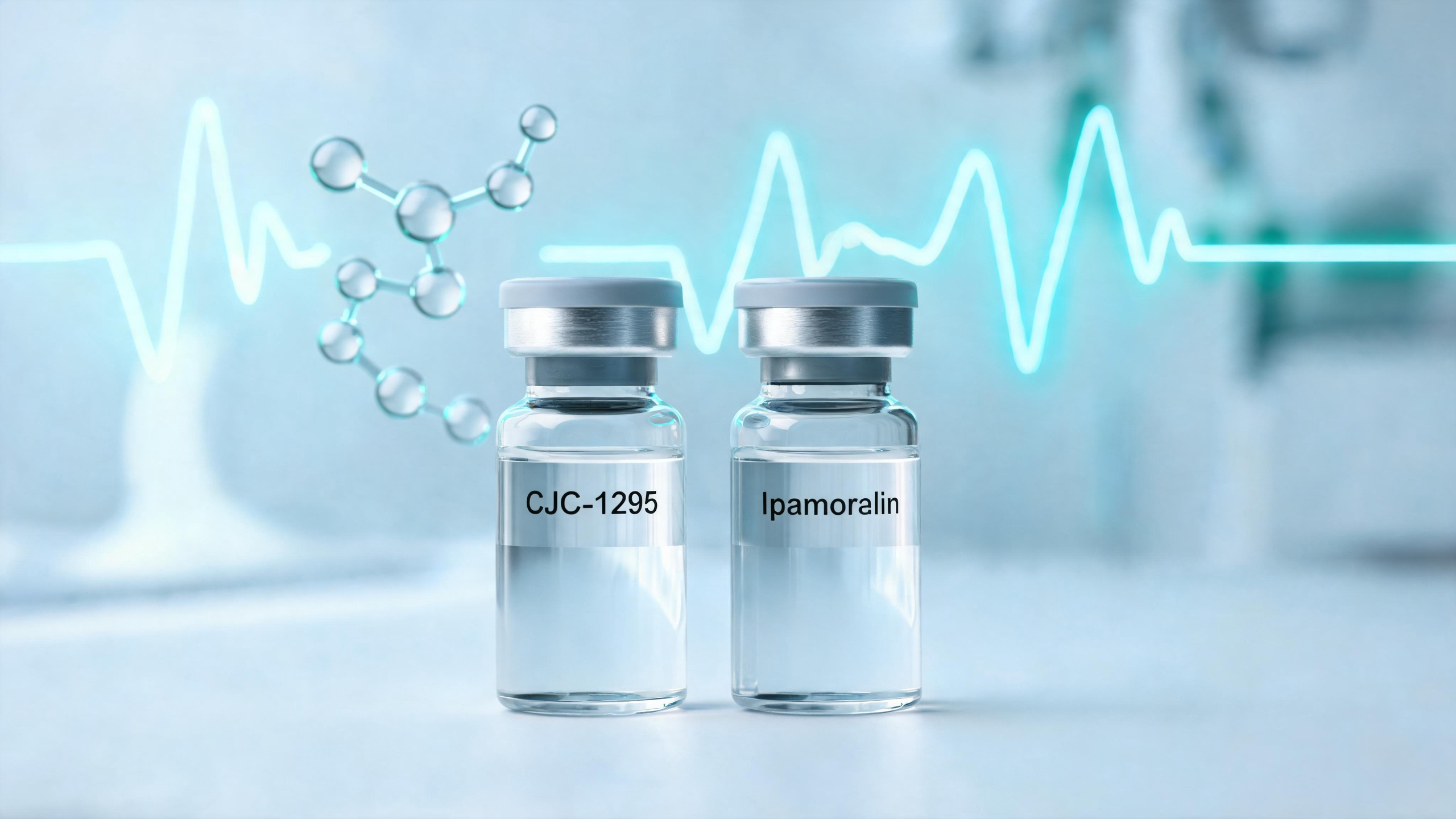
CJC-1295 (a GHRH analog) combined with Ipamorelin (a selective GHS-R1a agonist) represents the most analytically characterized entry point into growth hormone secretagogue (GHS) receptor pharmacology, with extensive community documentation across ExcelMale and GLP1Forum. The most common reason for research workflow discontinuation — Ipamorelin-mediated appetite signaling — is a pharmacodynamic confirmation of compound activity at the target receptor, not a research workflow failure or unexpected secondary observation.
GHS-R1a Receptor Pharmacology: Appetite Signaling as a Positive Bioassay
Ipamorelin is a selective agonist at the growth hormone secretagogue receptor 1a (GHS-R1a), the endogenous receptor for ghrelin. Receptor binding produces two simultaneous effects that are pharmacologically inseparable: anterior pituitary somatotroph GH release (the desired research endpoint) via Gαq/11-PLC-IP3-Ca2+ signaling, and hypothalamic appetite circuit activation (the ghrelin-mimetic effect) via NPY/AgRP neuron depolarization in the arcuate nucleus. The appetite signaling spike is not a research workflow observation to be managed — it is the built-in bioassay confirming GHS-R1a receptor engagement at pharmacologically active concentrations.
Central GHS-R1a receptors undergo homologous desensitization following sustained agonist exposure. After approximately 2-3 experimental cycles of consistent GHS-R1a agonism, receptor internalization via beta-arrestin-2 recruitment reduces surface receptor density, and appetite signaling intensity diminishes significantly. Research Workflow discontinuation during the first experimental cycle due to appetite signaling observations represents premature termination based on a transient, mechanistically predicted pharmacodynamic effect — the receptor adaptation period is a normal component of GHS-R1a pharmacology.
Pharmacodynamic Synergy: GHS-R1a + GLP-1R Co-Activation
The combination of Ipamorelin (GHS-R1a agonist) with a GLP-1 receptor agonist (Tirzepatide or Retatrutide) creates a pharmacologically rational co-application research workflow. GLP-1R activation in hypothalamic POMC/CART neurons directly antagonizes ghrelin-mediated NPY/AgRP neuron activation through GABAergic inhibitory interneurons. Community data indicates this co-application reduces Ipamorelin-induced appetite signaling by approximately 70% — an effect that is mechanistically predicted by the known inhibitory connectivity between POMC and NPY/AgRP neuronal populations in the arcuate nucleus.
This is not polypharmacy in the pejorative sense; it is a rationally designed receptor-level intervention where the GLP-1R pathway provides targeted inhibition of the specific hypothalamic circuit activated by GHS-R1a agonism. The two receptor systems converge on overlapping neuronal populations with opposing functional effects, making their co-modulation pharmacodynamically coherent.
DAC vs. No-DAC: The Somatotroph Desensitization Evidence
| With DAC | Without DAC | |
| Half-life | ~7-10 days | ~30 minutes |
| Application frequency | 2x per experimental cycle | 3x per experimental cycle |
| Somatotroph desensitization | High risk (3-6 cycles) | Minimal |
| Community preference | Lower | Higher |
The DAC problem: The Drug Affinity Complex (DAC) moiety binds CJC-1295 covalently to albumin, extending its half-life from approximately 30 minutes to 7-10 days. This creates continuous, non-pulsatile GHRH receptor activation at the somatotroph level. Sustained GHRH-R agonism without the physiological pulsatile pattern triggers receptor desensitization through GRK2-mediated phosphorylation and subsequent beta-arrestin recruitment. By experimental cycle 3-6, GH output per GHRH-R activation event declines measurably in community-reported data. Critically, switching from DAC to no-DAC formulation does not fully restore baseline somatotroph sensitivity — the desensitization has a slow-recovery component that may require extended washout periods exceeding 8-12 weeks.
For research workflows extending beyond 8 experimental cycles, the no-DAC formulation is the unequivocal community preference. The pulsatile GHRH-R activation pattern preserves receptor sensitivity and more closely mimics endogenous GHRH physiology — hypothalamic GHRH neurons fire in discrete bursts governed by ultradian oscillators in the arcuate nucleus, not continuous secretion. Pharmacological fidelity to this endogenous pattern is the key determinant of long-term somatotroph responsiveness.
Circadian Alignment of the GH Axis
The endogenous GH secretory profile is circadian — the largest GH pulse occurs during the sleep-phase cortisol nadir, approximately 60-90 minutes after sleep onset in research models with entrained light-dark cycles. Aligning CJC-1295/Ipamorelin application with this circadian window provides two advantages: (1) the pharmacological GH pulse superimposes on the endogenous pulse, maximizing total somatotroph output through additive secretory vesicle recruitment, and (2) GHS-R1a-mediated appetite signaling occurs during the rest phase when research model activity is minimal, reducing the research workflow impact of this pharmacodynamically predicted receptor-level effect.
Ourovia research note: The no-DAC formulation, applied via precision transfer instrument with pre-filled cartridges stored at 2-8°C, provides the optimal balance of receptor pharmacology fidelity and research workflow convenience. For research workflows exceeding 8 experimental cycles, the pulsatile delivery pattern preserves somatotroph sensitivity in a manner that continuous GHRH-R agonism cannot match — the GRK2/beta-arrestin desensitization cascade is fundamentally a function of receptor occupancy duration, not total agonist exposure.